
Designing Decision Systems Under Ambiguity
A structured approach to understanding how decisions are made — and why they fail — in complex environments.
The Problem: Decision Failure is Structural
Most decisions are judged by:
- accuracy
- speed
- experience
But these are surface-level.
👉 What actually determines performance is:
how truth is established inside the system
Two teams can arrive at the same answer —
but through completely different structures.
One is reliable.
The other is fragile.
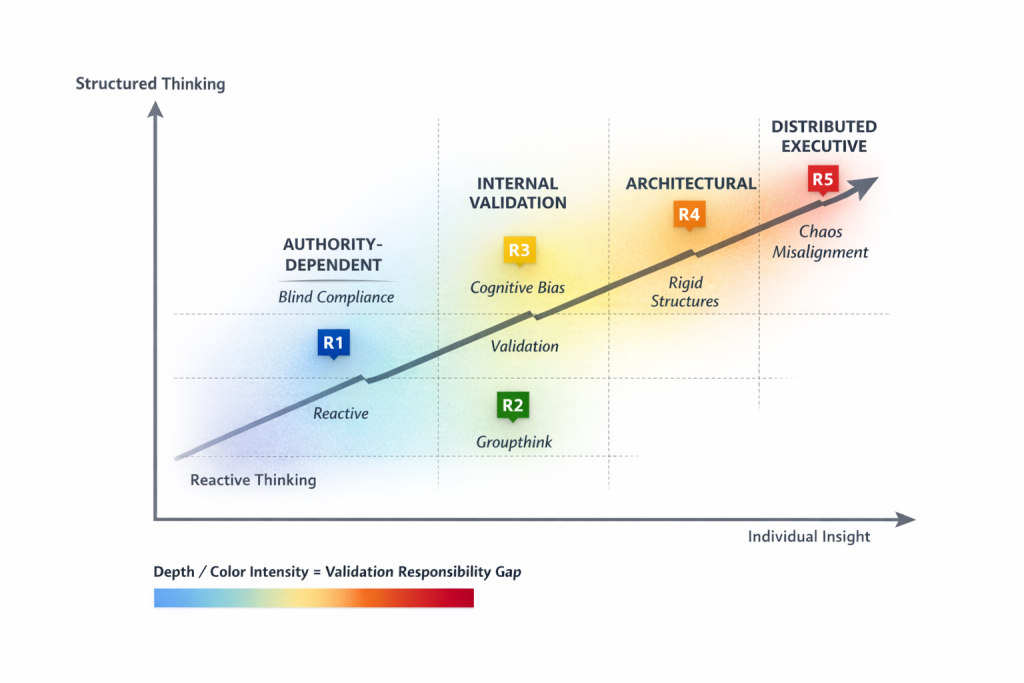
The Model
Every decision system is defined by how it generates and validates truth.
All decisions under ambiguity are shaped by two variables:
Validation Ownership
Who is responsible for determining what is true?
Hypothesis Architecture
How structured is the thinking behind the decision?
Together, these define how a system behaves under uncertainty.
Why this Matters
Decisions are not just outcomes.
They are the result of:
- how hypotheses are formed
- how they are validated
When structure is invisible:
- failure appears random
- patterns go unnoticed
- systems cannot improve
When structure is visible:
- patterns become predictable
- failure modes become identifiable
- systems become designable
Five Decision Systems
When these dimensions combine, five system types emerge:
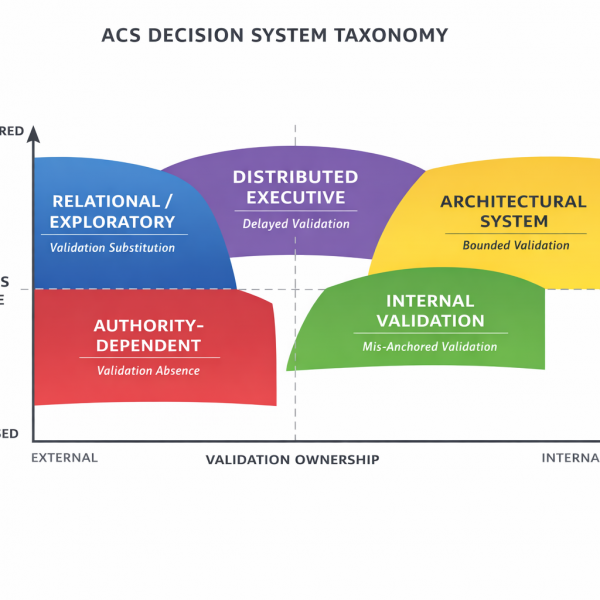
System Types (Taxonomy)
Authority-Dependent
External validation
Low structure
⚠️ Failure: Blind compliance
Relational / Exploratory
Collaborative
Loosely validated
⚠️ Failure: Validation substitution
Internal Validation
Self-driven validation
Limited anchoring
⚠️ Failure: Mis-anchored validation
Architectural
Structured
Process-driven validation
⚠️ Failure: Rigid structures
Distributed Executive
Scalable
Coordinated validation across systems
⚠️ Failure: Delayed validation
Where Does Your System Sit?
- Do decisions rely on authority or precedent?
- Does validation happen after the fact?
- Are assumptions explicitly tested — or implied?
👉 If you’re unsure, your system is likely operating reactively.
👉 Every team operates within one of these systems — whether it’s visible or not.
👉 Most teams don’t realize which one they’re operating in.
👉 The difference is whether it’s designed — or accidental.
👉 Each system has predictable strengths — and predictable failure modes.
Designing Better Decision Systems
Better decisions are not trained.
They are designed.
Core Design Principles:
- Reduce the Validation Responsibility Gap
- Bring validation closer to the point of decision
- Make validation explicit and observable
- Introduce multi-anchor validation
- Design systems for structured challenge
👉 These principles shift decision-making from reactive to engineered.
From Framework to Application
The ACS Framework is applied through:
👉 This is where the framework becomes observable.
ACS Labs
Hands-on environments to diagnose and redesign real decision systems
ACS Performance Reports
Structured diagnostics that measure decision system behavior
Measure how decisions are actually being made — not just outcomes
Research Foundation
The ACS Framework is grounded in applied observation across domains:
- healthcare systems
- software engineering
- sales and discovery
- executive decision-making
🔍 What We’re Seeing Across ACS Labs
- Participants consistently overestimate validation rigor in early phases
- Decisions appear correct but fail under pressure
- Most systems operate in reactive or mis-anchored states
👉 Most decision systems are accidental. Yours doesn’t have to be.
👉 The cost of poor validation isn’t visible — until it compounds.
Start Designing Better Decisions — Now
Whether you’re analyzing workflows, leading teams, or building systems — ACS provides a structured way to improve decision-making under ambiguity.
40-minute session. No preparation required.