
Why Smart Teams Fail Under Ambiguity
Part 1 of a 4-part ACS Research Note on decision-making under ambiguity
Over the past several months I’ve been running a series of decision labs across multiple domains — pharmacy operations, sales discovery, software debugging, and executive strategy.
What emerged surprised me.
The biggest driver of decision failure wasn’t intelligence, experience, or even data.
It was validation architecture.
Introducing the ACS Model
To better understand why decision failures occur — even in experienced teams — I began mapping how decisions are actually made under ambiguity.
What emerged was a consistent pattern.
Across roles, industries, and scenarios, decisions were not failing randomly.
They were failing in predictable, repeatable ways.
And those patterns could be explained by a simple structure:
- How validation is handled
- How hypotheses are formed and managed
The ACS Model
The ACS (Analyst Cognitive Stewardship) model is a framework designed to classify how decisions are made when the correct answer is not immediately clear.
Rather than focusing on outcomes alone, ACS focuses on the structure of decision-making itself.
At its core, the model is built on two primary dimensions:
- Validation Ownership
- Hypothesis Architecture
Together, these dimensions define how a system approaches uncertainty — and where it is most likely to fail.
Why This Matters
In most environments, decision quality is evaluated based on:
- Accuracy
- Speed
- Experience
But these are surface-level indicators.
What actually determines performance is:
how truth is established inside the system
Two individuals can arrive at the same answer —
but through completely different validation structures.
One may be reliable.
The other may be fragile.
The difference is not visible unless you understand the underlying system.
From Behavior to System
The goal of the ACS model is to shift the perspective from:
What decision was made
to
How that decision was constructed
Because once the structure becomes visible:
- Patterns become predictable
- Failure modes become identifiable
- Systems become improvable
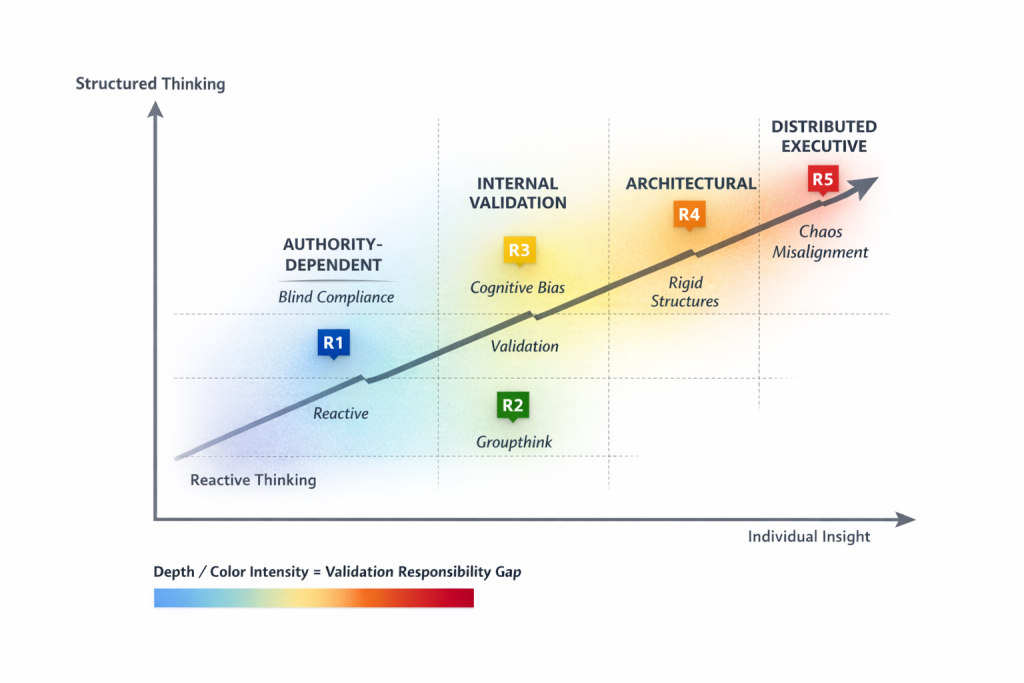
The model below illustrates how decision systems can be mapped based on these dimensions.
In Part II, we’ll introduce the model that reveals why these failures aren’t random—and how decision systems consistently form under ambiguity.