

How Decisions Take Shape Under Ambiguity
Part II of a 4-part ACS Research Note on decision-making under ambiguity
In Part I, we introduced a core idea:
Decision failure is not random.
It is structural.
Across domains, teams were not failing because of a lack of intelligence, effort, or even data.
They were failing because of how decisions were constructed.
To understand why, we need a model.
Two Dimensions That Shape Every Decision
When decisions are made under ambiguity, two variables consistently determine how the system behaves:
- Validation Ownership
- Hypothesis Architecture
These are not surface-level traits.
They define how a system establishes truth.
Validation Ownership
Validation ownership answers a simple question:
Who is responsible for determining whether something is true?
In some systems, validation is:
- Externalized — delegated to QA, leadership, or downstream review
- Distributed — shared across roles
- Internalized — owned by the individual making the decision
This matters because validation is not just a step.
It is the control mechanism of the system.
When validation is weak, delayed, or misplaced:
- Errors persist longer
- Assumptions go unchallenged
- Risk accumulates silently
Hypothesis Architecture
Hypothesis architecture answers a different question:
How structured is the thinking behind the decision?
At one end, thinking is:
- Reactive — driven by immediate signals, incomplete framing
At the other, it is:
- Structured — deliberate, layered, and context-aware
This dimension determines whether a system is:
- Exploring
- Guessing
- Testing
- Engineering
Why These Dimensions Matter Together
Individually, these variables are important.
Together, they define the system.
A decision is never just:
- “right” or “wrong”
- “fast” or “slow”
It is the product of:
- how hypotheses are formed
- and how they are validated
Two systems can produce the same outcome —
but with completely different levels of reliability.
One is stable.
The other is fragile.
The Model
When we map these two dimensions together, a structure begins to emerge.
- The horizontal axis represents Validation Ownership
- The vertical axis represents Hypothesis Architecture
At the extremes:
- Validation can be external or internal
- Thinking can be reactive or structured
This creates a simple but powerful coordinate system.
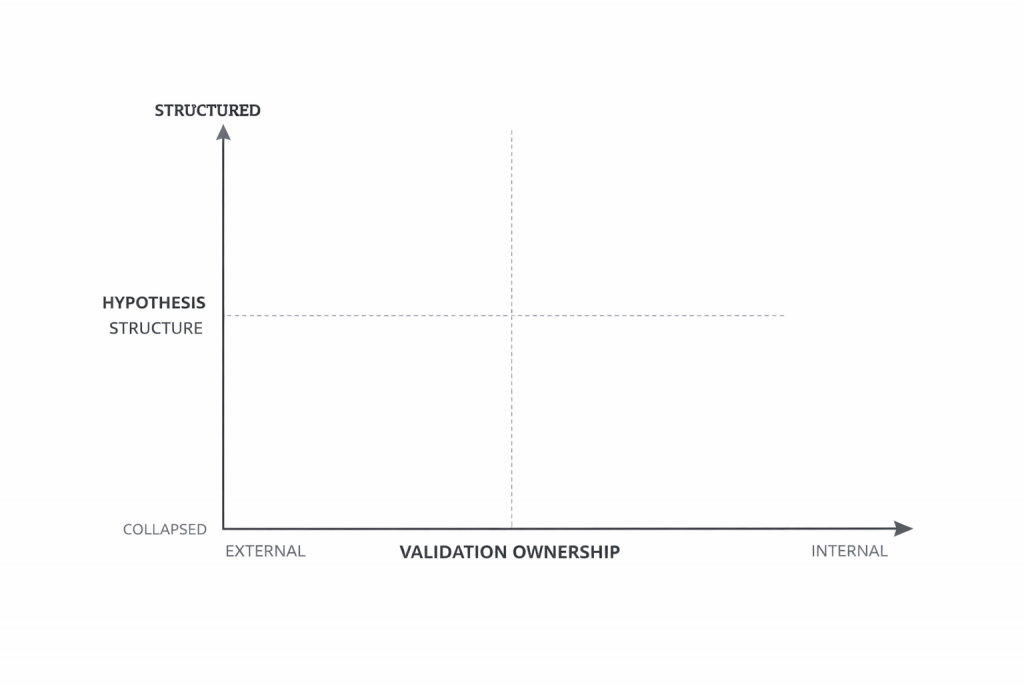
This model does not tell us what decision was made.
It tells us how the system that produced the decision is built.
From Structure to Pattern
Once this structure is visible, something important happens:
Decisions stop looking isolated.
They begin to cluster.
Patterns emerge.
Not because people are similar —
but because systems behave consistently under the same structural conditions.
These patterns are not theoretical.
They are observable across domains, roles, and levels of experience.
And they form a small number of distinct decision system types.
In Part III, we’ll map these patterns directly.
We’ll look at the five distinct decision systems that emerge from this model —
and why each fails in a different way.


