

How Decision Systems Actually Behave
Part III of a 4-part ACS Research Note on decision-making under ambiguity
In Part II, we introduced a model:
Two dimensions —
Validation Ownership and Hypothesis Architecture —
that define how decisions are constructed under ambiguity.
Once these dimensions are mapped, something important happens:
Decisions stop appearing random.
They begin to form patterns.
From Model to System
When these two dimensions interact, they produce a small number of recurring system types.
These systems are not defined by intelligence or experience.
They are defined by:
- how thinking is structured
and - how validation is handled
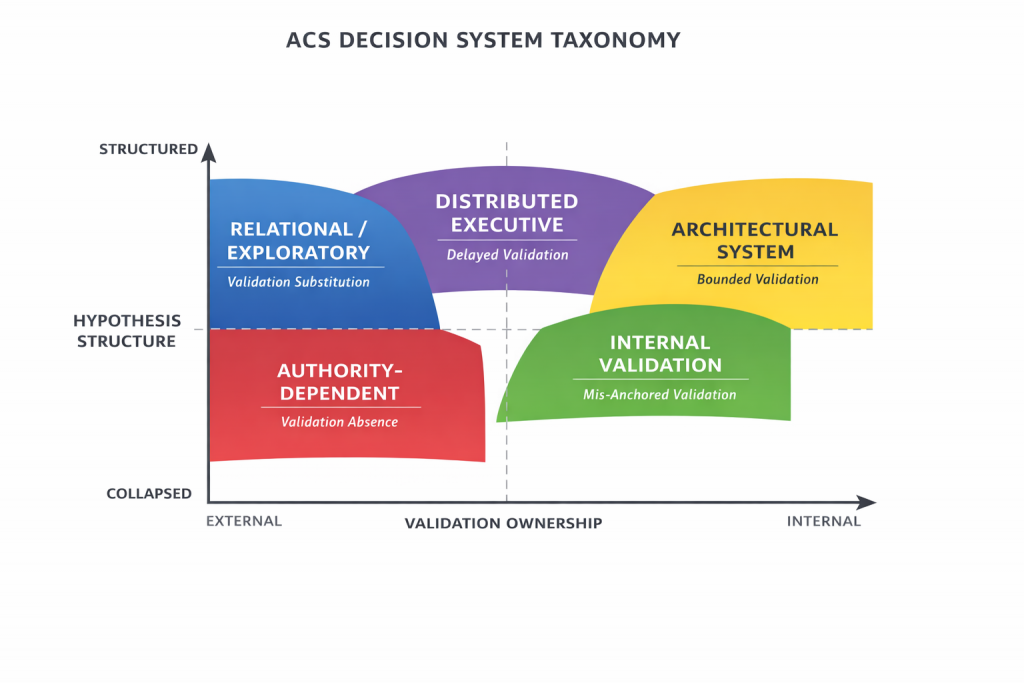
Each region of the model represents a fundamentally different way of making decisions.
Each has strengths.
Each has failure modes.
1. Authority-Dependent System
Validation Absence
In this system:
- Validation is externalized
- Hypothesis structure is weak or collapsed
Decisions are driven by:
- authority
- precedent
- instruction
This creates speed — but at a cost.
Failure Mode: Blind Compliance
Assumptions are not tested.
Errors are not challenged.
The system relies on correctness upstream — whether or not it exists.
2. Relational / Exploratory System
Validation Substitution
In this system:
- Hypothesis structure begins to form
- But validation remains external or informal
Decisions are driven by:
- collaboration
- discussion
- pattern recognition
This creates flexibility — but lacks control.
Failure Mode: Validation Substitution
Instead of testing truth, the system substitutes:
- agreement
- intuition
- social alignment
3. Internal Validation System
Mis-Anchored Validation
In this system:
- Validation shifts inward
- Individuals begin owning correctness
This is a meaningful step forward.
But something subtle happens:
Failure Mode: Mis-Anchored Validation
Validation exists —
but it is anchored to:
- incomplete models
- cognitive bias
- local reasoning
The system improves — but remains unstable.
4. Architectural System
Bounded Validation
In this system:
- Hypothesis structure becomes deliberate
- Validation is embedded into the process
Decisions are:
- designed
- tested
- iterated
This creates consistency and reliability.
Failure Mode: Rigid structures
The system becomes constrained by its own architecture.
- over-reliance on process
- reduced adaptability
- difficulty handling novel ambiguity
5. Distributed Executive System
Delayed Validation
At the highest level:
- Validation is distributed across the system
- Hypothesis structure is highly developed
Decisions are:
- coordinated
- scalable
- system-aware
But complexity introduces a new challenge:
Failure Mode: Delayed validation
Validation still occurs —
but too late.
This leads to:
- misalignment
- compounding errors
- systemic drift
What This Reveals
These systems are not stages.
They are patterns.
Any team, role, or organization can operate in any of them — depending on how decisions are structured.
More importantly:
Each system fails in a predictable way
Not because people are flawed —
but because the structure makes certain failures inevitable.
The Hidden Variable: Validation Responsibility Gap
Across all systems, one factor consistently amplifies failure:
The distance between:
- who makes the decision
- and who validates it
As this gap increases:
- errors persist longer
- assumptions go untested
- risk becomes invisible
From Awareness to Design
Once these systems are visible, decision-making changes.
You stop asking:
“Was this the right decision?”
And start asking:
“What system produced this decision?”
Because if the system is flawed:
🔑 outcomes will eventually follow
What Comes Next
In the final part, we shift from analysis to application.
In the Takeaway, we’ll look at how to design decision systems intentionally —
and how to reduce failure by restructuring validation itself.


