picture1

Defined Reality vs. Bounded Reality

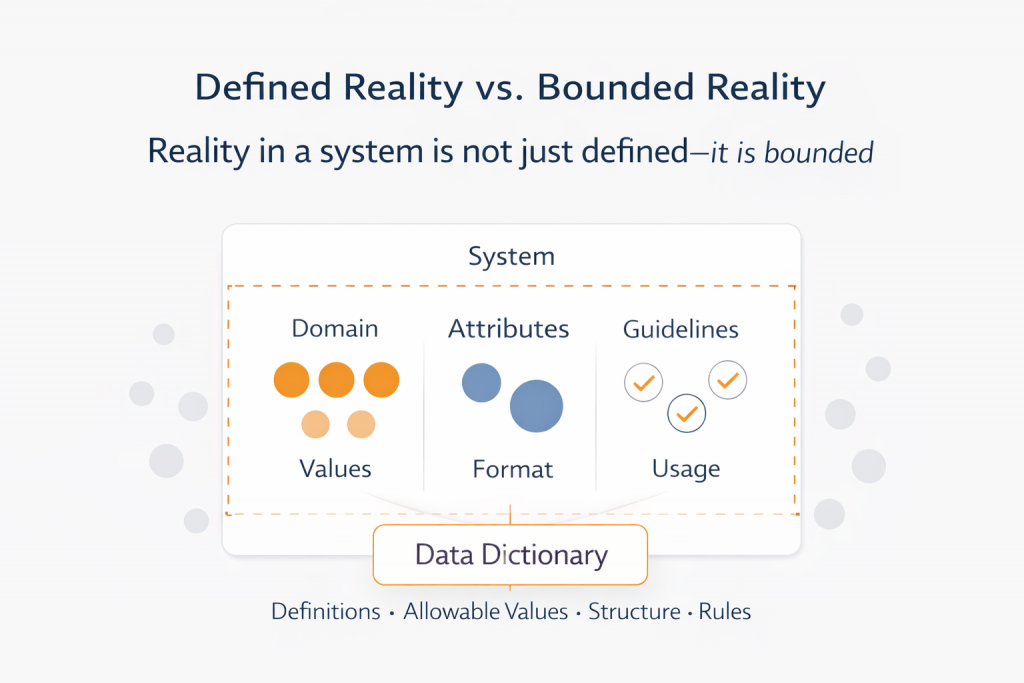
Reality in a system is not just defined—it is bounded.

defined vs bounded reality infographic

Context

Data dictionary — defined reality vs. bounded reality

Observation

A data dictionary includes definitions, allowable values (domain), attributes, and usage guidelines for each data element.

Pattern

Data dictionaries define not only what data exists, but how those elements can be represented and used within a system.

Insight

Reality in a system is not just defined—it is bounded.

The data dictionary constrains representation through allowable values (domain), structure (attributes), and usage rules (guidelines).

Application

The data dictionary directly influences CDS accuracy, alert precision, and clinician trust by shaping the signal-to-noise ratio and the fidelity of the reality represented in the system.

🔄 What This Means in Practice

•A narrow domain can oversimplify reality and miss clinical nuance

•A broad domain can introduce noise and reduce signal clarity

•Poorly defined attributes can distort how data is interpreted

•Inconsistent usage guidelines can lead to variability in downstream logic

⚖️ The Calibration Problem

Bounded too tightly → loss of nuance

Bounded too loosely → loss of signal

ACS Perspective

From an Analyst Cognitive Stewardship™ perspective, bounded reality directly shapes reasoning conditions.

If the system constrains representation too tightly or too loosely, it alters:

• how clinicians interpret signals

• how analysts validate evidence

• how much trust users place in the system

Leave a Comment

Your email address will not be published. Required fields are marked *

Scroll to Top