
Why Better Technology Doesn’t Guarantee Better Outcomes
The Promise of AI
Healthcare is investing heavily in artificial intelligence.
- Predicting readmissions
- Reducing medical errors
- Optimizing staffing and operations
- Improving revenue cycle performance
- Personalizing patient engagement
The expectation is clear:
Better technology → better outcomes
And in many ways, that’s true.
AI is improving how healthcare systems:
- process information
- identify patterns
- generate predictions
The Problem
Despite these advances:
Outcomes still vary—sometimes dramatically
Two organizations can implement the same tools
and achieve completely different results.
Two clinicians can receive the same recommendation
and make different decisions.
Two leaders can review the same data
and choose different paths forward.
Why?
Because:
AI improves inputs.
Decisions determine outcomes.
The Missing Layer: Decision Intelligence
Healthcare has invested heavily in:
- data
- analytics
- predictive models
But far less in understanding:
how decisions are actually made
Decision Intelligence focuses on:
- how information is interpreted
- how uncertainty is handled
- how trade-offs are structured
- how actions are ultimately chosen
It’s not about what the system can do.
It’s about:
what people actually do with it
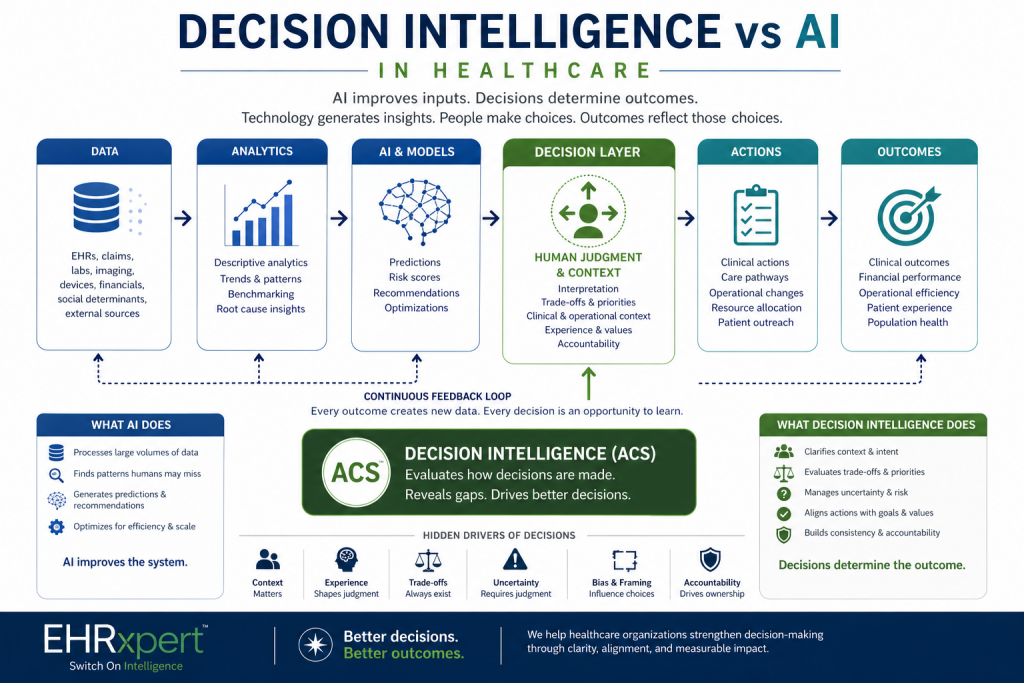
AI improves inputs. Decisions determine outcomes.
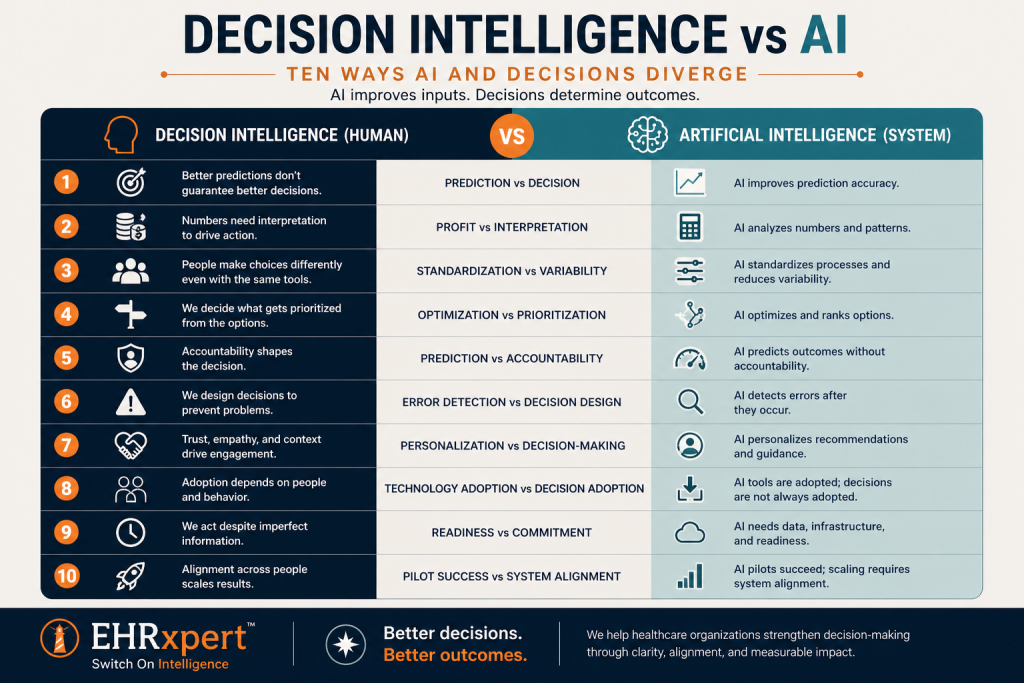
Ten Ways AI and Decisions Diverge
Across healthcare, the same pattern appears repeatedly:
1. Prediction vs Decision
AI improves prediction accuracy.
But:
Better predictions don’t guarantee better decisions
2. Profit vs Interpretation
Financial performance is constructed through accounting rules.
The numbers may be accurate—
but interpretation determines action
3. Standardization vs Variability
AI reduces variability in systems.
But:
decision-making remains inconsistent
4. Optimization vs Prioritization
Systems can optimize what should happen.
But:
leaders still decide what actually gets prioritized
5. Prediction vs Accountability
AI predicts outcomes.
But:
humans remain accountable for decisions
6. Error Detection vs Decision Design
AI can catch errors.
But:
it doesn’t fix how decisions are made upstream
7. Personalization vs Decision-Making
AI improves engagement and guidance.
But:
guidance is not the same as decision-making
8. Technology Adoption vs Decision Adoption
Organizations implement tools.
But:
if decision behavior doesn’t change, adoption fails
9. Readiness vs Commitment
Organizations wait for better data, funding, or infrastructure.
But:
progress depends on decisions—not perfect conditions
10. Pilot Success vs System Alignment
AI pilots often succeed in isolated environments.
But:
scaling requires aligned decision-making across teams
The Decision Intelligence Manifesto
The Pattern
Across all of these:
AI improves the system
Decisions determine the outcome
This is why:
- strong models still fail
- well-designed systems underperform
- high-potential initiatives stall
The issue isn’t capability.
It’s:
decision-making under real-world conditions
The Hidden Drivers of Decisions
Decisions are influenced by factors rarely measured:
- how information is framed
- which assumptions are accepted
- how risk is perceived
- when escalation occurs
- how trade-offs are structured
These are not technical problems.
They are:
decision architecture problems
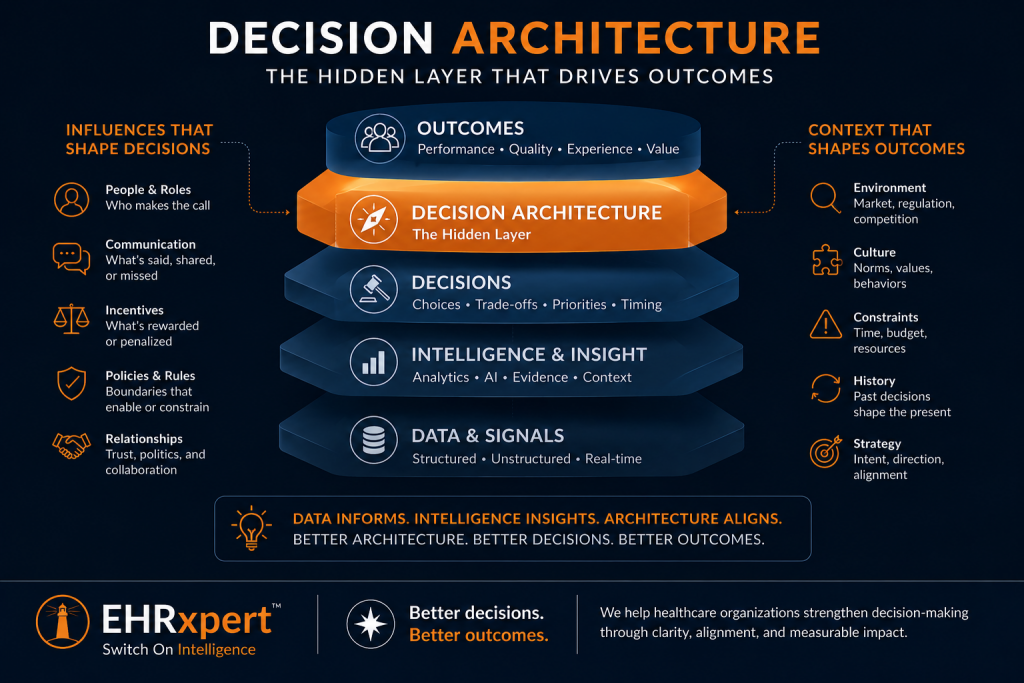
Most decisions are influenced by factors that aren’t visible in the data.
Why This Matters Now
Healthcare is becoming:
- more data-rich
- more automated
- more complex
As systems improve, the bottleneck shifts.
Not to technology.
But to:
how decisions are made within those systems
A New Layer of Performance
Improving outcomes now requires more than:
- better models
- better data
- better systems
It requires:
better decision-making
This is the role of Decision Intelligence:
- making decision patterns visible
- evaluating how decisions are made under ambiguity
- identifying variability across individuals and teams
- improving consistency, speed, and effectiveness
Closing
AI will continue to transform healthcare.
But it won’t replace the need for decisions.
And it won’t fix how decisions are made.
Better technology doesn’t guarantee better outcomes.
Better decisions do.